
Tallow vs Shea Butter: Which Is Better?
When deciding between tallow and shea butter for skincare, your choice depends on what your skin needs most. Tallow, derived from animal fat, mimics human sebum and absorbs quickly, delivering deep nourishment with vitamins A, D, E, and K. It's ideal for repairing the skin barrier, calming inflammation, and balancing oil production. Shea butter, sourced from shea nuts, works as a surface-level moisturizer, forming a protective layer that locks in hydration. It’s great for soothing irritation, softening rough areas, and shielding against dryness.
Quick Overview:
- Tallow: Deeply absorbed, supports skin repair, anti-inflammatory, non-greasy.
- Shea Butter: Surface hydration, protective barrier, rich texture, vegan-friendly.
Quick Comparison:
| Feature | Tallow (Grass-Fed) | Shea Butter (Unrefined) |
|---|---|---|
| Source | Animal (Beef/Sheep Fat) | Plant (Shea Nut) |
| Absorption | Deep and fast (2–3 mins) | Surface-level (5–10 mins) |
| Key Vitamins | A, D, E, K | A, E |
| Skin Benefits | Repairs, nourishes | Hydrates, protects |
| Best For | Sensitive, aging, eczema | Dry, cracked, rough skin |
| Texture | Light, whipped | Thick, creamy |
| Price | Higher ($5–$15/oz) | Affordable ($0.60–$2.50/oz) |
If you need deep repair and fast absorption, go for tallow. For heavy-duty hydration and surface protection, shea butter is a solid choice. Or, combine both for the best of both worlds!
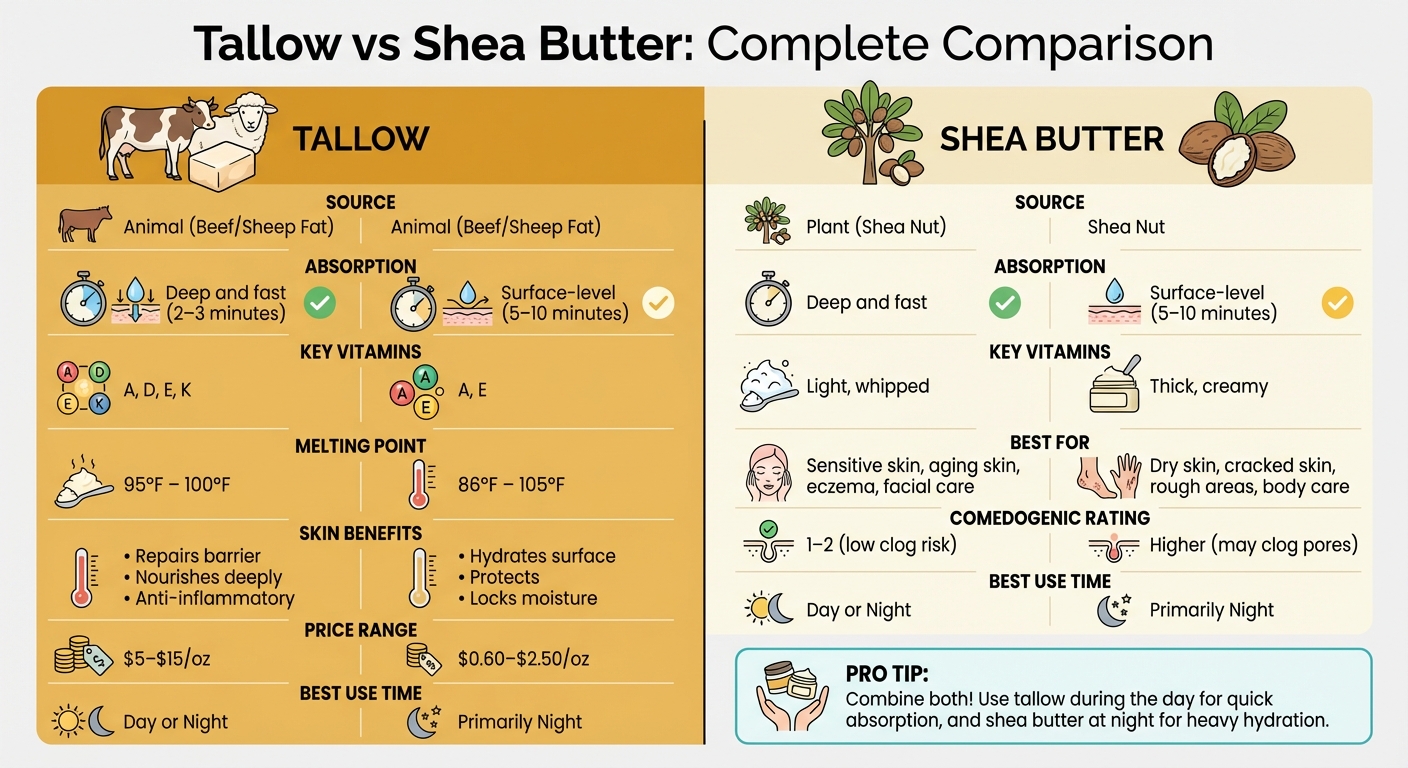
Tallow vs Shea Butter: Complete Skincare Comparison Chart
DIY Beauty | Tallow & Shea Body Butter
sbb-itb-2185835
Nutrient Content: Tallow vs Shea Butter
Taking a closer look at the nutrient profiles of tallow and shea butter reveals why they work so differently on the skin. Both are rich in fat-soluble vitamins and fatty acids, but their unique compositions influence how they nourish and repair.
Nutrients in Tallow
Grass-fed beef tallow is packed with a wide array of fat-soluble vitamins, including vitamins A, D, E, and K - a combination that's not often found in plant-based ingredients. Each of these vitamins plays a vital role:
- Vitamin A: Encourages cell turnover and supports collagen production .
- Vitamin D: Strengthens the skin's barrier and enhances its immune response to environmental stress.
- Vitamin E: Acts as a powerful antioxidant, protecting against free radicals and aiding in deep healing .
- Vitamin K (K2): Improves elasticity and helps with redness, age spots, and dark circles .
Additionally, tallow contains Conjugated Linoleic Acid (CLA), a rare fatty acid known for its anti-inflammatory properties, which can calm skin irritation and reinforce the barrier . Another standout is palmitoleic acid (omega-7), a lipid naturally found in youthful skin that helps maintain structural integrity. With a fatty acid composition of about 50–55% saturated fats, 40–45% monounsaturated fats, and only 3–4% polyunsaturated fats, tallow is highly stable and resistant to oxidation.
"Grass-fed beef tallow contains significantly higher levels of vitamins A, D, E, and K than grain-fed varieties."
– Four Rivers Skincare
In contrast, shea butter offers a different set of nutrients, primarily targeting the skin's surface.
Nutrients in Shea Butter
Shea butter shines with its vitamins A and E, along with plant-based compounds that provide unique benefits. While it shares these two vitamins with tallow, it lacks the vitamins D and K that make tallow distinct. What makes shea butter special are its plant-specific compounds:
- Allantoin: Soothes irritation and promotes healing.
- Lupeol: Delivers anti-inflammatory effects.
- Phytosterols: Strengthen the skin barrier.
It also contains cinnamic acid esters, which offer antioxidant protection and a touch of natural UV defense . The fatty acid profile of shea butter includes 45–50% oleic acid, 35–40% stearic acid, 4–8% palmitic acid, and 3–5% linoleic acid. This composition provides deep hydration and forms a protective barrier on the skin. Linoleic acid, in particular, can help soothe conditions like eczema. However, shea butter mainly works as an occlusive, sealing in moisture on the skin's surface without penetrating deeply .
Nutrient Comparison Table
Here's a side-by-side look at the nutrient profiles and benefits of tallow and shea butter:
| Nutrient | Tallow (Grass-Fed) | Shea Butter (Unrefined) | Primary Skin Benefit |
|---|---|---|---|
| Vitamin A | High (Retinol) | Moderate | Cell turnover and regeneration |
| Vitamin D | Present | Absent | Barrier function and immune response |
| Vitamin E | High | High | Antioxidant protection and healing |
| Vitamin K | Present (K2) | Absent | Elasticity and reduction in redness |
| Key Compounds | CLA, Palmitoleic Acid | Allantoin, Lupeol, Phytosterols | Anti-inflammatory and soothing |
| Fatty Acids | Palmitic, Stearic, Oleic | Oleic, Stearic, Linoleic | Moisture retention and barrier support |
| Absorption Rate | Fast (2–3 minutes) | Moderate (5–10 minutes) | Depth of nutrient delivery |
The standout difference is in bioavailability. Tallow closely mimics human sebum, allowing its nutrients to penetrate deeply and support cellular repair . Studies show that tallow-based products can increase skin moisture by nearly 50% within hours. Meanwhile, shea butter acts mainly as an emollient, locking in moisture on the surface rather than delivering nutrients to deeper layers .
Texture and How They Absorb
The way a moisturizer feels on your skin matters just as much as its nutrient content. Tallow and shea butter deliver very different sensory experiences, and knowing these differences can help you decide which fits better into your skincare routine. Let’s dive into how their textures and absorption rates affect their performance.
How Tallow Feels and Absorbs
Grass-fed beef tallow has a light, whipped texture, similar to soft shortening rather than a heavy balm. With a melting point between 95°F and 100°F, it melts on contact with your skin and absorbs within 2–3 minutes, blending seamlessly into the skin's natural lipid barrier. It spreads effortlessly without pulling, delivering hydration deep into the skin while keeping the surface soft and breathable. This quick absorption makes tallow a great option for daytime use or as a base under makeup.
"Where shea butter sits heavily on the skin's surface, tallow penetrates. This is thanks to its high concentrations of palmitic and oleic acids - lipids the skin already recognizes and uses to repair itself."
– Garden Club
How Shea Butter Feels and Absorbs
Shea butter, on the other hand, has a thicker, creamier texture straight from the jar. With a melting point ranging from 86°F to 105°F, it doesn’t melt as easily as tallow and often benefits from a little warming to spread smoothly.
Once applied, shea butter forms a rich, protective layer on the skin. It typically takes 5 to 10 minutes to absorb fully, leaving behind a slight breathable film. This occlusive quality makes it excellent for locking in moisture and shielding the skin from external irritants, making it particularly useful for nighttime applications.
Texture and Absorption Comparison Table
| Feature | Tallow | Shea Butter |
|---|---|---|
| Primary Texture | Light, whipped, shortening-like | Thick, creamy, substantial |
| Melting Point | 95°F – 100°F | 86°F – 105°F |
| Absorption Speed | Fast (2–3 minutes) | Moderate to Slow (5–10 minutes) |
| Skin Feel | Light, non-greasy | Rich, occlusive, slightly waxy |
| Residue | Minimal | Moderate |
| Best Use Time | Day or Night | Primarily Night |
Which Works Better for Different Skin Types
When it comes to choosing between pure, grass-fed tallow and traditional shea butter, understanding how each works with different skin types can make all the difference. Your skin type - whether dry, sensitive, acne-prone, or affected by conditions like eczema - plays a big role in determining which moisturizer will work best. Both tallow and shea butter bring their own strengths to the table, but their effectiveness varies depending on your skin's needs.
Tallow for Different Skin Types
Grass-fed beef tallow stands out because its fatty acid profile closely resembles human sebum. This makes it easy for the skin to absorb and use effectively. For dry skin, tallow provides the specific lipids your skin needs to restore natural oil production. It also supports deep barrier repair thanks to fat-soluble vitamins like A, D, E, and K.
Sensitive skin tends to benefit from tallow’s simplicity. Its hypoallergenic properties and ability to blend seamlessly with natural skin oils make it a gentle option. For conditions like eczema and psoriasis, tallow's conjugated linoleic acid (CLA) helps reduce inflammation, while vitamins A and K promote elasticity and long-term healing. Acne-prone skin can also find relief with tallow. Its sebum-like qualities help balance oil production, and with a low comedogenic rating of 1–2, it’s less likely to clog pores. That said, patch testing is wise for those with particularly sensitive or oily skin.
While tallow shines in deep repair, shea butter offers a different kind of benefit for the skin.
Shea Butter for Different Skin Types
Shea butter is all about creating a barrier to lock in hydration. It’s especially effective for dehydrated or weather-damaged skin, thanks to its occlusive properties. By forming a protective layer on the skin’s surface, it helps prevent moisture loss. This makes it ideal for very dry areas like elbows, heels, and knees, where its rich, creamy texture can soothe cracked or flaky skin. Its vitamins A and E, along with anti-inflammatory compounds like lupeol and cinnamic acid, work to calm irritation and itching.
Sensitive skin generally tolerates shea butter well, though a patch test is advised for those with nut allergies, as it’s derived from the shea nut. For eczema-prone skin, it offers a protective shield against environmental irritants while reducing surface-level discomfort with its cinnamic acid content. However, because it primarily works on the surface rather than penetrating deeply, it’s better for short-term hydration than long-term barrier repair. Acne-prone skin may find shea butter too heavy, as its thicker consistency can sometimes clog pores if overused.
Ultimately, the choice between tallow and shea butter comes down to whether your skin needs deep repair or surface-level protection and hydration.
Skin Type Comparison Table
| Skin Type | Tallow Performance | Shea Butter Performance |
|---|---|---|
| Dry / Lipid-Depleted | Rebuilds oil production and supports deep repair | Provides immediate relief and prevents moisture loss |
| Sensitive | Mimics natural skin oils; highly absorbable | Gentle and soothing, but patch test for nut allergies |
| Acne-Prone | Balances sebum with a low clogging risk (1–2 rating) | Can feel heavy; may clog pores if overapplied |
| Eczema / Psoriasis | Reduces inflammation and supports healing | Forms a protective shield; reduces itching |
| Aging / Mature | Boosts collagen and elasticity with vitamins A and K | Offers antioxidant protection with vitamin E |
How to Use Each in Your Skincare Routine
Both tallow and shea butter can be powerful additions to your skincare routine, but their effectiveness depends on how you use them. Each has unique properties that cater to different skin needs, so knowing when and where to apply them can make all the difference. Below, you'll find tips on how to incorporate these ingredients into your daily regimen.
Best Ways to Use Tallow
Tallow, especially when sourced from grass-fed animals, is a fantastic daily facial moisturizer. A pea-sized amount applied to damp skin after cleansing locks in moisture without leaving a greasy residue. Its melting point matches body temperature, allowing it to absorb quickly - ideal for use under makeup or as an all-day hydrator.
For targeted healing, tallow is a go-to for soothing inflammatory skin conditions like eczema, psoriasis, or rosacea. Rich in conjugated linoleic acid (CLA) and vitamin D, it helps reduce redness and calm irritated skin. It also works wonders as a healing salve for cracked skin, minor burns, or even new tattoos, thanks to its vitamins E and K, which aid in repair and elasticity.
When it comes to anti-aging, tallow shines as a nighttime balm or a gentle treatment for the delicate eye area. Its natural vitamin A content promotes cell turnover and collagen production without the harsh side effects of synthetic retinol. During colder months or in dry climates, tallow provides essential barrier support, helping to rebuild the skin’s lipid layer to prevent moisture loss.
For those with extremely dry skin, try a layering approach: apply a water-based serum first, then seal it in with tallow. This method ensures maximum hydration while allowing tallow to integrate seamlessly into your skin’s natural lipid barrier.
While tallow is perfect for quick absorption and deep repair, shea butter’s thicker consistency makes it better suited for creating a long-lasting protective barrier.
Best Ways to Use Shea Butter
Shea butter excels in body care, particularly for rough, dry areas like elbows, knees, and feet. Its thick texture forms a durable barrier, locking in moisture and softening tough skin. For smoother application, warm a small amount in your palms before use.
For overnight care, shea butter is unmatched. Its heavy occlusive properties are perfect for severely dry or cracked skin, preventing moisture loss while you sleep. Apply it to damp skin or layer it over a water-based product like hyaluronic acid to boost hydration.
Shea butter also works well as a post-shave treatment or for weather-damaged skin. Its lupeol and cinnamic acid content help soothe irritation and protect against external stressors. Additionally, it’s an excellent deep conditioner for dry scalps or coarse hair textures, a role tallow typically doesn’t fulfill.
For those with very dry facial skin, shea butter can act as a protective winter layer, though its thicker texture may feel too heavy for everyday use. If you have nut allergies, remember to patch test first, as shea butter is derived from tree nuts.
Skincare Uses Comparison Table
| Application | Tallow | Shea Butter |
|---|---|---|
| Daily Face Moisturizer | Absorbs quickly; works under makeup | Feels heavier; better for very dry skin |
| Body Moisturizer | Great for general hydration and healing | Ideal for large areas; cost-effective |
| Rough Areas | Repairs cracked skin | Forms a thick, lasting barrier |
| Anti-Inflammatory | Reduces inflammation with CLA and vitamin K | Soothes surface irritation |
| Overnight Treatment | Repairs barrier and promotes cell turnover | Prevents moisture loss with occlusive layer |
| Eye Area | Gentle and non-irritating | Too thick for this delicate area |
| Post-Shave/Sun Care | Supports deep healing | Calms redness and provides protection |
| Hair/Scalp | Not typically used | Excellent for conditioning coarse hair |
Which One Should You Choose?
Now that we've covered nutrient profiles, textures, and how each ingredient suits different skin types, let's figure out which one fits your skincare goals.
If you're looking for deep barrier repair, quick absorption, and nutrient-packed support, grass-fed tallow is a standout option. Its lipid profile closely resembles human sebum, which means it integrates smoothly into your skin's natural barrier instead of just sitting on the surface. This makes it especially beneficial for aging or sensitive skin, delivering essential vitamins like A, D, E, and K that work on a cellular level.
On the other hand, shea butter is a great pick if you need a vegan-friendly, heavy-duty moisturizer. It creates a thick protective layer, locking in moisture and soothing surface irritation. This makes it perfect for tackling severely dry areas like your legs or elbows, or for all-over body care.
Ultimately, the best choice depends on your skin's specific needs. If you're aiming for advanced skincare benefits - like managing eczema or combating premature aging - tallow tends to offer better absorption and long-term support. However, you don't have to choose just one. You can combine them: use tallow during the day for its lightweight, non-greasy feel, and save shea butter for nighttime hydration on particularly dry spots.
Curious about what tallow can do for your skin? Keep an eye out for our upcoming skincare line featuring pure grass-fed tallow. Join the waitlist to be among the first to experience its regenerative benefits!
FAQs
Will tallow clog pores or cause breakouts?
Tallow is often regarded as low on the comedogenic scale, meaning it’s unlikely to clog pores. This is largely because its fatty acid composition is quite similar to human sebum. When it comes from high-quality, grass-fed animals and doesn’t include added fragrances or oxidized oils, it tends to work well for a variety of skin types. That said, if you have oily or acne-prone skin, it’s a good idea to do a patch test or opt for lighter formulations to see how your skin reacts.
Is shea butter safe if I have a nut allergy?
Refined shea butter is widely regarded as safe for individuals with nut allergies. Research shows it does not contain the proteins that typically trigger allergic reactions. That said, if you’re unsure or have specific concerns, it’s always a good idea to check with a healthcare professional before using it.
Can I layer tallow and shea butter together?
Yes, you can use tallow and shea butter together in your skincare routine. When combined, they bring together a mix of animal- and plant-based fats that help boost hydration and nourishment. To get the most out of these ingredients, start with lighter products first, then apply tallow or shea butter as the last step to seal in moisture. This method is especially helpful for dry or sensitive skin, as it provides intense repair and supports the skin's natural barrier.