
Fixing Irritated Skin with Tallow-Based Solutions
If your skin feels dry, itchy, or inflamed, it might be time to rethink your skincare routine. Many products, even "natural" ones, contain harsh ingredients that strip your skin's natural barrier, leading to irritation. Tallow-based skincare offers a simple, effective alternative. Why? Because tallow closely resembles human sebum, making it easy for your skin to absorb. It’s packed with vitamins (A, D, E, K) and fatty acids that help repair and hydrate your skin while reducing inflammation.
Key Takeaways:
- Why irritation happens: Over-cleansing, harsh products, and environmental factors weaken your skin barrier, causing redness, dryness, and sensitivity.
- How tallow helps: Its nutrient-rich profile mimics your skin’s natural oils, promoting hydration and barrier repair without clogging pores.
- Best uses: Tallow balms for spot treatments (eczema, dry patches) and whipped tallow moisturizers for daily hydration.
For the best results, choose grass-fed tallow with minimal ingredients. Apply it to damp skin to lock in moisture and support healing. Whether you’re dealing with eczema, psoriasis, or general dryness, tallow-based products can provide soothing relief.
What Causes Irritated Skin
Common Irritation Triggers
Your skin faces a lot of challenges daily. Cold winter air, for example, can strip away the natural oils that keep your skin soft and protected. On top of that, dry indoor heating pulls even more moisture from your skin, leaving it dehydrated and vulnerable.
Over-cleansing is another culprit. While foaming cleansers might make your skin feel squeaky clean, they often remove the protective lipids that hold your skin cells together. Using harsh soaps with ingredients like sodium lauryl sulfate can gradually weaken your skin’s natural barrier, making it less effective at keeping irritants out.
Environmental pollutants also play a role. These pollutants create oxidative stress, which can be especially harmful when your skin’s protective layer is already damaged. Combine this with over-exfoliation, and the result is chronic irritation. This ongoing damage weakens your skin’s ability to protect itself - a topic we’ll dive into further.
How a Damaged Skin Barrier Leads to Irritation
Picture your skin barrier as a well-built wall. The outer layer, known as the stratum corneum, is made up of skin cells (the "bricks") held together by a lipid matrix of ceramides, cholesterol, and fatty acids (the "mortar"). When this structure is compromised, it allows moisture to escape - a process called transepidermal water loss (TEWL) - and makes it easier for irritants, bacteria, and pollutants to get in.
This sets off a chain reaction. Your immune system kicks in with inflammation, which causes the redness, swelling, and discomfort you feel. Over time, a damaged barrier makes your skin more sensitive, even to products that never bothered it before. Minor injuries, like cuts and scrapes, may also take longer to heal when your skin’s protective layer isn’t working properly.
"When the skin's barrier is compromised, it becomes more vulnerable to irritation and skin sensitivities that could potentially lead to conditions such as eczema & rosacea." - Dr. Rhys Branman, Cosmetic Surgeon
The key to breaking this cycle isn’t about piling on more products. Instead, it’s about giving your skin the specific lipids it needs to rebuild its barrier. Restoring this balance is essential to stopping moisture loss and calming irritation. This sets the stage for tallow’s potential to help repair and strengthen your skin, which we’ll explore next.
Why Tallow Works for Irritated Skin
Vitamins and Fatty Acids in Tallow
Tallow is remarkably similar to human sebum, containing palmitic and oleic acids that blend effortlessly into the skin's natural barrier. This compatibility allows the skin to absorb tallow easily, incorporating it into its lipid structure.
"Beef tallow does indeed contain saturated and unsaturated fats - like palmitic acid, stearic acid, and oleic acid - which are naturally found in human skin and could make for an effective barrier repair product."
– Adam Friedman, Professor and Chair of Dermatology, GW School of Medicine and Health Sciences
Tallow is packed with Vitamins A, D, E, and K, which are essential for promoting cell turnover, strengthening the skin barrier, offering antioxidant protection, and supporting the healing process. Grass-fed tallow, in particular, can contain up to four times more Vitamin E than its grain-fed counterpart.
Its saturated fats help reinforce the lipid bilayer, reducing moisture loss. Oleic acid, which makes up 40–50% of tallow, boosts absorption, while linoleic acid helps reduce inflammation. These components work together to nourish the skin, setting the stage for tallow's impressive anti-inflammatory and antimicrobial effects.
Anti-Inflammatory and Antimicrobial Properties
Beyond its nutrient content, tallow contains CLA (conjugated linoleic acid) and palmitoleic acid, which help reduce redness and combat bacteria.
A 2024 review of 19 studies highlighted that the combination of oleic, palmitic, and stearic acids in tallow provides therapeutic relief for conditions like dermatitis and psoriasis, while also promoting wound healing. One study involving 78 participants found that a tallow-based topical emulsion acted as a disinfectant and significantly improved skin hydration for those with atopic dermatitis and psoriasis. Unlike synthetic antibacterial agents that can disrupt the skin's balance, tallow's antimicrobial lipids help maintain a healthy microbiome.
These qualities work together to soothe irritated skin. The anti-inflammatory components help reduce redness and discomfort by calming the immune response, while the antimicrobial elements guard against secondary infections. Thanks to tallow's biocompatible structure, these active ingredients penetrate deeply into the skin's outer layer, restoring the barrier and easing irritation.
Tallow Products for Irritated Skin
Using Tallow Balm for Spot Treatment
Tallow balm works wonders for targeting specific areas of irritation. Its thick, concentrated texture makes it perfect for addressing dry patches on elbows, knees, and heels, as well as soothing eczema flare-ups or cracked skin.
To use, take a small amount and warm it between your fingertips for a few seconds. This softens the balm, making it easier to spread. For the best results, apply it to slightly damp skin - this helps lock in moisture and can increase hydration by up to 30%. On sensitive or inflamed areas, gently press the balm into the skin instead of rubbing, and let it sit for 2–5 minutes to fully absorb before covering the area.
For everyday hydration across larger areas, a lighter tallow moisturizer may be a better choice.
Using Tallow Moisturizer for Daily Care
Whipped tallow moisturizers are great for daily use thanks to their light, airy texture. They spread easily, absorb quickly, and leave your skin feeling soft without that greasy residue.
When choosing a facial moisturizer, look for formulas that combine tallow with light, non-comedogenic oils like jojoba or rosehip. These oils absorb quickly and won’t clog your pores. Body moisturizers, on the other hand, often include richer oils like coconut or olive oil to provide extra nourishment for thicker skin. Just like with tallow balm, applying the moisturizer to slightly damp skin after cleansing helps seal in moisture. A small, pea-sized amount is usually enough to reinforce your skin’s natural barrier.
How to Choose the Right Tallow Product
To get the most out of tallow products, go for options made from grass-fed, grass-finished tallow. This type is richer in Vitamin E and offers added anti-inflammatory properties. Look for products that specify the use of "suet", which is the nutrient-packed fat from around the kidneys. Avoid generic trim fat, as it lacks the same benefits.
A neutral, buttery scent is a good indicator of proper rendering. If the product has a strong odor, it might not have been purified correctly. For sensitive or irritated skin, stick to formulas with minimal ingredients - ideally just tallow and one complementary oil. Avoid synthetic fragrances, preservatives, or unnecessary fillers that might cause irritation.
With its natural nutrient profile, tallow is versatile enough to meet both spot treatment and daily hydration needs.
| Product Type | Best For | Texture |
|---|---|---|
| Tallow Balm | Spot treatment, cracked heels, eczema | Dense, waxy, and rich |
| Whipped Tallow | Daily facial care, full-body moisturizing | Light, airy, and easy to spread |
| Tallow with Lanolin | Extremely dry or damaged skin barriers | Very heavy, intensive repair |
High-quality grass-fed tallow products typically cost between $25 and $45 for a 4oz jar. Cheaper options under $15 might use grain-fed tallow or fillers, while pricier ones over $50 often include specialty botanical infusions.
sbb-itb-2185835
Beef Tallow for Face? Dermatologist Breaks Down the Truth Behind the Skincare Trend
How to Apply Tallow Correctly
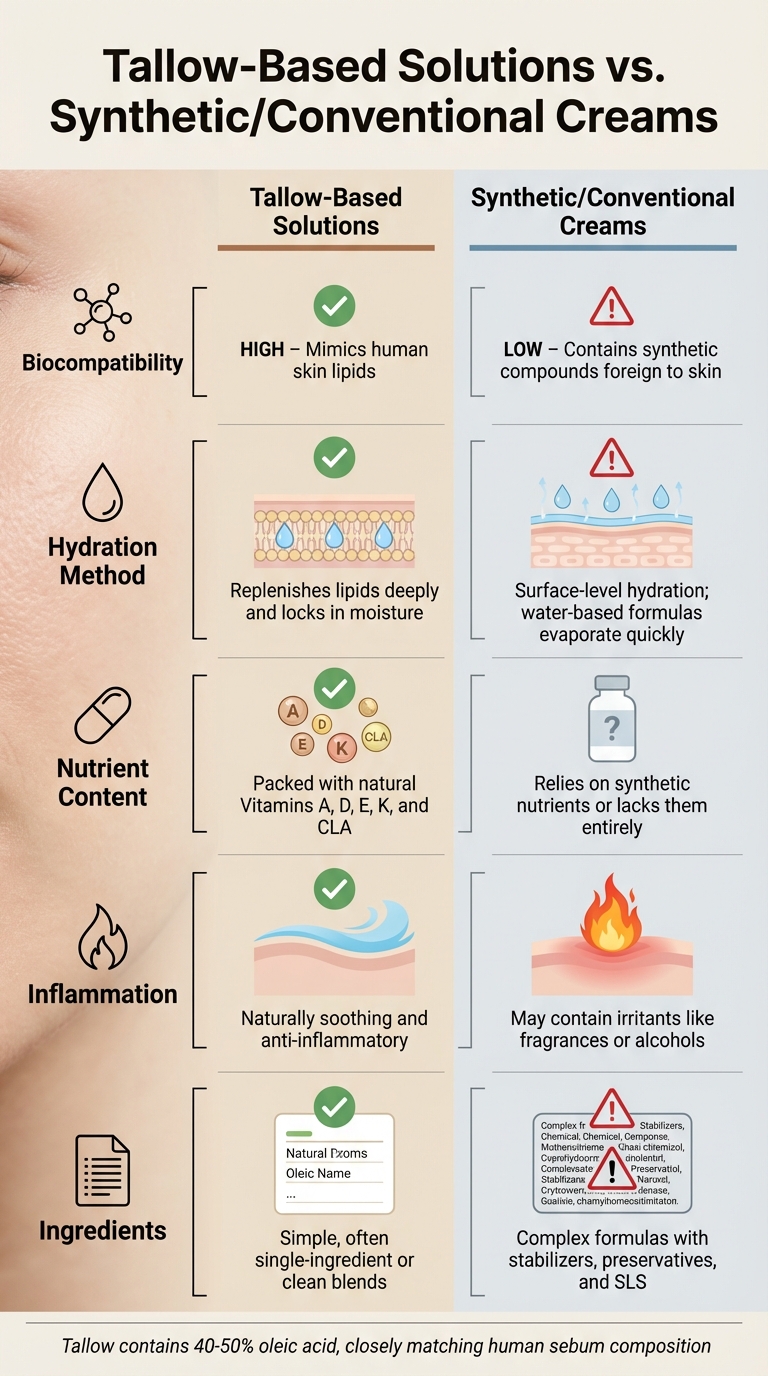
Tallow vs Synthetic Creams: Skincare Ingredient Comparison
Step-by-Step Application Guide
Start by cleansing your skin with a gentle, non-foaming cleanser. Pat your skin dry, but leave it slightly damp - this helps retain up to 30% more moisture. Take a pea-sized amount of tallow and warm it between your fingertips until it melts into a smooth texture. Once melted, press the tallow gently into your skin rather than rubbing it, as this minimizes irritation. If you use water-based serums like hyaluronic acid or Vitamin C, apply them first, wait for 30–60 seconds, and then seal it all in with the tallow.
For an overnight boost, apply a thicker layer of tallow before bed. Let it absorb for 2–5 minutes to ensure maximum effectiveness.
"Tallow-based skincare helps your skin remember how to function without interference." - Maloney Healing
This process showcases how tallow's natural, nutrient-rich composition can surpass synthetic alternatives, supporting your skin's ability to repair its barrier and stay healthy.
Tallow vs. Synthetic Creams
One of the standout features of tallow is its compatibility with human skin. Its fatty acid profile - 40-50% oleic acid - closely resembles the makeup of human sebum, making it easy for your skin to absorb and utilize. On the other hand, synthetic creams often rely on ingredients like petroleum-based occlusives or dimethicone, which tend to sit on the surface without nourishing deeper layers.
To better grasp these differences, here’s a comparison of tallow and synthetic creams:
| Feature | Tallow-Based Solutions | Synthetic/Conventional Creams |
|---|---|---|
| Biocompatibility | High; mimics human skin lipids | Low; includes synthetic compounds foreign to skin |
| Hydration Method | Replenishes lipids deeply and locks in moisture | Provides surface-level hydration; water-based formulas evaporate quickly |
| Nutrient Content | Packed with natural Vitamins A, D, E, K, and CLA | Relies on synthetic nutrients or lacks them entirely |
| Inflammation | Naturally soothing and anti-inflammatory | May contain irritants like fragrances or alcohols |
| Ingredients | Simple, often single-ingredient or clean blends | Complex formulas with stabilizers, preservatives, and SLS |
Tallow also boasts Conjugated Linoleic Acid (CLA), which provides natural antimicrobial and anti-inflammatory benefits. Unlike tallow, synthetic creams often require preservatives that can irritate sensitive skin, making tallow a gentler, more nourishing choice for many.
Conclusion
Tallow-based skincare offers a nutrient-rich, skin-friendly solution for managing irritation. Thanks to its lipid profile, which closely resembles human sebum, tallow is quickly absorbed by the skin, promoting deeper hydration and aiding in barrier repair.
Grass-fed tallow, in particular, is packed with beneficial nutrients like Vitamin E, CLA, and Omega-3 fatty acids, which help calm redness and irritation. Research backs its effectiveness - a 2024 review of 19 studies highlighted tallow's positive impact on conditions like dermatitis, psoriasis, dry skin, and wound healing. With the tallow skincare market expected to hit $403.01 million by 2032, it's clear this age-old remedy is making a strong comeback.
For the best results, choose 100% grass-fed, grass-finished, anhydrous tallow products. Applying a pea-sized amount to damp skin ensures maximum nutrient absorption and moisture retention.
Join the Waitlist for Pure, Grass-Fed Tallow Skincare
Curious about how grass-fed tallow can transform your skincare routine? Sign up for the waitlist at Pure Skin Tallow. Our products are designed to provide simple, chemical-free care that aligns with your skin's natural needs while supporting regenerative farming. Be the first to know when our tallow balms and moisturizers launch - join today!
FAQs
Will beef tallow for skin clog pores or cause breakouts?
Beef tallow is not likely to clog pores or trigger breakouts. Its structure is similar to the skin's natural oils and is packed with fatty acids that help reinforce the skin barrier. These qualities allow it to nourish and protect the skin without causing blockages, making it a mild choice for a variety of skin types.
How long does it take for a tallow moisturizer to calm irritation?
A tallow moisturizer often starts easing irritation within just a few hours to a couple of days. Many people notice a calming effect as quickly as 24 hours after applying it. However, the results can differ based on how severe the irritation is and the specific needs of your skin.
Can I use a tallow balm for face if I have eczema or psoriasis?
Yes, you can apply tallow balm to your face if you're dealing with eczema or psoriasis. Tallow is often praised for its soothing and calming effects, which may help ease irritation and support the skin's natural barrier. Although scientific studies on tallow's benefits are limited, many people with sensitive or inflamed skin find its nutrient-rich formula helpful.